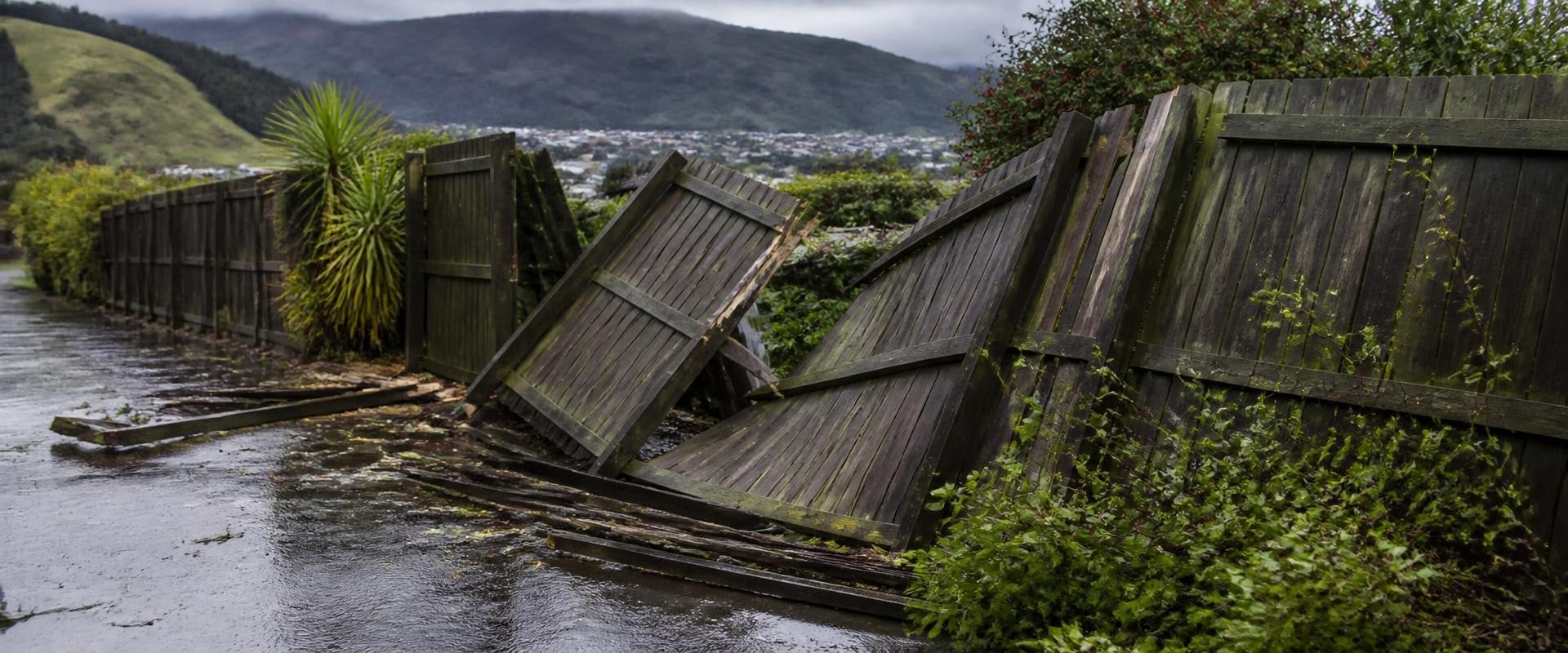
A southerly comes through overnight, and in the morning a stretch of the back fence is lying in the neighbour's garden. Or a tree has come down across it. The questions are always the same: is it safe, can it be fixed, and who pays?
Make it safe first, photograph everything, then look hard at the posts before you decide anything. For a shared boundary fence, the Fencing Act lets either neighbour get urgent repairs done straight away and ask the other for half. Your house insurance may cover your share, as long as the damage was sudden and not years of rot.
Why Hutt Valley fences come down
Wellington is windy because it sits at the gap between two mountain ranges, with Cook Strait running through it. A close-boarded paling fence catches that wind like a sail, because there is nothing to let it through.
When a fence goes over, it is rarely the palings that failed. It is usually the posts, snapped or rotted at ground level, where the timber stays wet longest. A storm finds the weakest posts in the run, and that matters when you decide how much to fix.
First, make it safe
- Keep children and pets away from a leaning section. Wet palings are heavy, and a half-fallen fence can go the rest of the way in the next gust.
- If a power line or a big tree is involved, stay clear and call the lines company or an arborist. Nobody can rebuild the fence until the tree is off it.
- Photograph the damage before anything is moved: the whole run, the broken posts up close, and the tree if there is one. Snapped timber and rotten timber look different, and your insurer will want to know which it was.
- Lay loose sections flat or tie back what is still standing. If the fence keeps a dog or a toddler in, put up something temporary today rather than waiting for the repair.
- Talk to your neighbour. The fence is usually half theirs, and everything after this is easier if you agree early.
Repair or replace? Check the posts
Push each post along the damaged run, then the ones either side. A sound post barely moves. Scrape back a little soil at the base and press a screwdriver into the timber at ground level. If it sinks in easily, the post is rotten, even if it is still standing.
If the posts are sound and only a bay or two of rails and palings came down, repair it. New rails and palings go onto the old posts and the fence lines up with the rest.
If the posts are soft along most of the run, patching only the fallen bay usually means the next one goes in the next storm. At that point, replacing the run costs less than repairing it twice. It is also when the timber matters: PlaceMakers' guide to posts and rails says posts in the ground should be at least H4 treated, with rails and palings H3.2.

Who pays for a shared boundary fence
Normally, a neighbour who wants fencing work done gives the other a fencing notice and waits up to 21 days for a reply. Storm damage is the exception. Under section 16 of the Fencing Act 1978, when a fence is damaged by sudden accident and needs immediate work, either neighbour can get it done without notice and recover half the cost from the other.
Two limits apply. Your neighbour only has to pay half of an adequate fence, meaning one reasonably satisfactory for its purpose. If you rebuild taller, or swap timber for aluminium, the extra is yours. And under section 17, if one neighbour is legally to blame for the damage, that neighbour pays all of it.
| What happened | Who usually pays |
|---|---|
| Wind blew down a shared fence | Half each, for an adequate replacement |
| A neighbour's healthy tree fell in the storm | Usually half each. A neighbour is generally not liable for storm damage |
| A neighbour's rotten tree fell, after they were asked to deal with it | Possibly the neighbour, in full, under section 17 |
| You want the new fence taller or in a different material | You pay the difference |
| The property is rented | The landlord, not the tenant |
The tree rows follow the Insurance Council's guide to trees and insurance: a neighbour is generally not liable for storm damage unless they were negligent, for example with a tree that was obviously rotten or that they had been asked to remove. If you can't agree, the Disputes Tribunal hears fencing disputes up to $60,000.
What insurance covers
The Natural Hazards Commission, the old EQC, does not cover fences, and storm damage to buildings is outside its cover anyway. So a storm-damaged fence is a claim on your own house insurance. Most house policies cover fences for sudden accidental damage, and most exclude wear and tear, rot and gradual deterioration.
That is why the photos matter. A post that snapped clean in a gale is storm damage. A post that rotted through at the base and finally fell in a gale may be treated as rot. Your policy also covers only your share of a shared fence, so your neighbour claims their half on their own policy or pays it. For a bay or two, the repair can cost less than your excess, so get a quote before you lodge a claim.
Rebuilding: consent and height
A fence up to 2.5 m above the ground doesn't need a building consent, under Schedule 1 of the Building Act 2004. It isn't restricted building work either, so it doesn't have to be built by a licensed building practitioner. Pool fences are different and always need consent. Both Hutt City's and Upper Hutt's district plans exempt fences up to 2 m from their building rules, so a like-for-like boundary fence is straightforward. If you want to go higher than the old fence, or you're rebuilding a front fence on the road boundary, check the council's ePlan or ring them first.
A retaining wall under the fence is a separate question. One holding back more than 1.5 m of ground, or carrying a load such as a driveway above it, needs consent.

Getting it fixed in the Hutt Valley
Whoever you call, ask them to check the posts along the whole run, not just the fallen bay, and to say in the quote whether old posts are being reused or replaced. That line is often where two quotes for the same broken fence differ.
Goodgame Building is one option close to home. Blair Goodgame is a licensed builder based in Upper Hutt who builds and repairs fences across Upper Hutt, Lower Hutt, Wellington, Kapiti and the Wairarapa, along with decks and retaining walls. Several of his customers' reviews describe exactly this situation, from a fallen section secured in the rain ahead of more bad weather to part of a high fence rebuilt after a tree came down on it.
If the whole run is being replaced, it is also a good time to think about how much upkeep you want from the new one. Our guide to low-maintenance fences compares the options.


